RE:VIEW ~ “The Anderson Tapes” (1971)
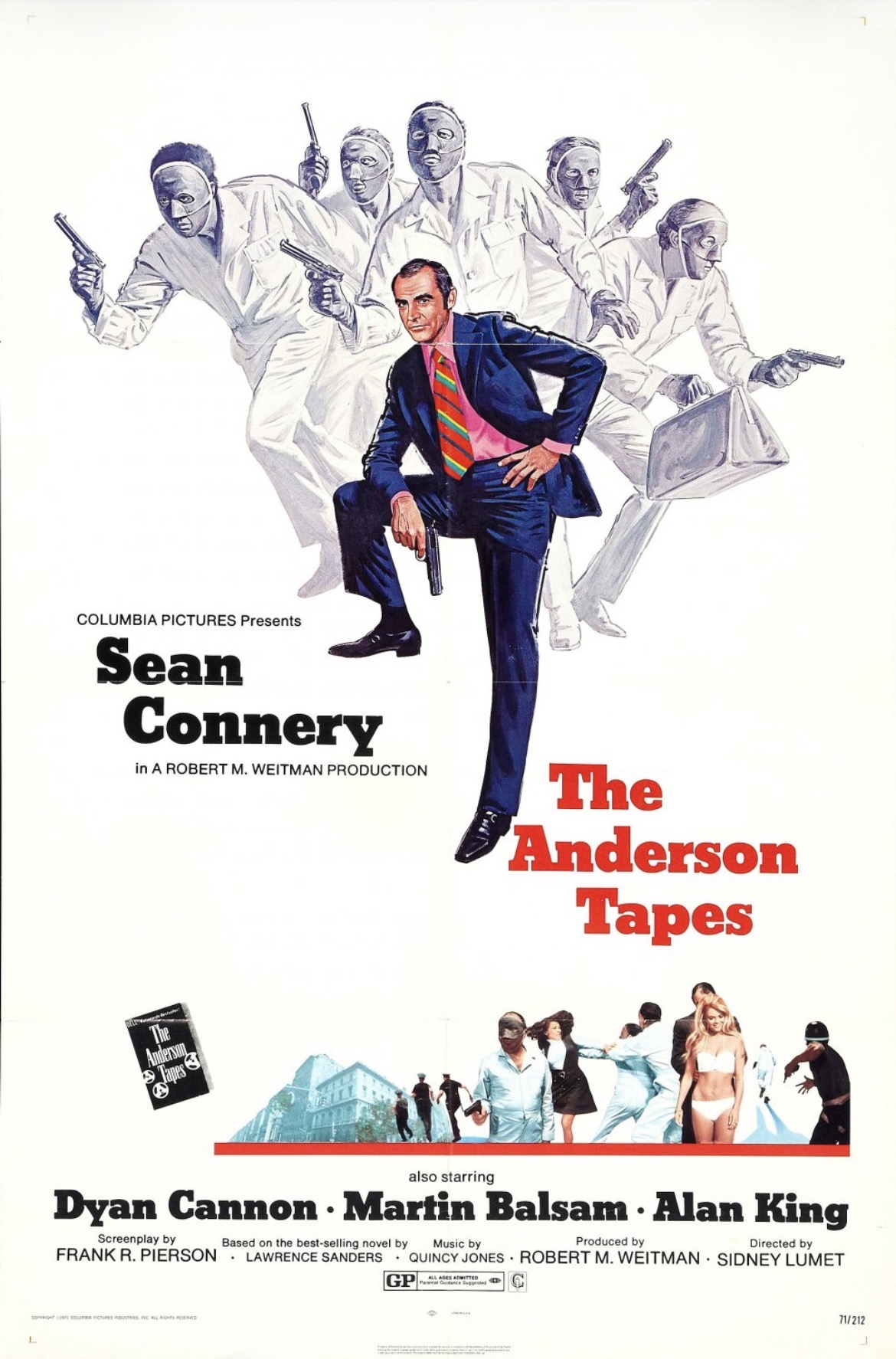
For all of his skill and confidence as an actor, Sir Sean Connery could never manage an accent beyond his own. Here he’s occasionally described as someone from England who’s lived in America for a couple of decades, which explains the occasional attempt to sound like someone from the Bowery or Bronx. He always ends up sounding more neutrally Scottish than anything.
Great action star, though! His dramatic and mild comedic acting was often solid, also.
Anyway, here, Sir Sean is a thief getting out of prison after a decade, for being involved in a murder, I think. He’s done it as a favour to some mobsters to keep someone of theirs out of jail. The details are scarce, as this is the early-’70s style of filmmaking where narratives are often thin. Ultimately it doesn’t matter beyond this, however. The mob owes him for his time inside, at least to some degree.
He has a plan to rob the entire building in which his casual partner / girlfriend / paramour / special lady-friend / fuck buddy lives (their relationship isn’t specified either, because this is the early-’70s). Each of the floors has only two suites on it (because this is the early-’70s and buildings like this hadn’t been subdivided into tiny boxes to make serious fortunes from rentals). These suites are owned by professionals who love art and have personal wealth to allow them to collect it (because this is the early-’70s . . .). But, of course, this is not just a thriller or heist film, it’s also a noir so no one is really likeable and crime does not pay.
The underlying theme here is of surveillance and a feeling of paranoia because of it. It’s a part of a series of films in the late-1960s and early-’70s which concerned government conspiracies, surveillance, and general societal paranoia. Everywhere he looks, Sir Sean’s character sees video cameras, or he’s having his photo taken while holding a cheque he’s depositing, or he feels that he’s being followed. There’s good reason for this: the F.B.I., the New York State’s Narcotics Division, the House Internal Committee, the Internal Revenue Service, and even an ex-boyfriend of Sir Sean’s casual partner are surveilling seemingly everyone in the story; there’s overlap of effort at times. Nearly all of this is likely illegal, as well.
Obviously, it’s not paranoia if people really are watching you all the time.
Were the characters in, or original viewers of, this film to see what’s happening today, they would probably move to the countryside and live in a carefully constructed Faraday Cage of a home.
Director Sidney Lumet makes great use of existing light when outside, and the interiors certainly appear to use nothing but practical lighting. This, plus a more sensitive film stock’s graininess, adds to a feeling of being in the rooms with the characters in the story. He always preferred to use real locations for everything including interiors, because he felt that sets built in the studio made for something less real; both for the actors and for the audiences. Thus, you’ll see the actual lobby of a building, its impressive curved staircase with mural-painted domed ceiling, and its physical plant with hot water and other machinery.
A bonus for this film is the incredible number of character actors you’ll see. Tom Bosley, Alan King, Martin Balsam, Dyan Cannon, Margaret Hamilton (in her final on-screen role), and future SNL cast member Garrett Morris all do excellent work. What a shame that more directors today don’t make use of actors such as these anymore.
If that’s not enough, this is the first motion picture role for Christopher Walken, earning him an “introducing…” credit at the film’s start. He’s great here with what is a small supporting role, carving out little unique things to make him distinct from the rest of the criminals.
The over-all problems I have with the picture — other than the sometimes too-thin narrative — is an inability of the story to make the Mafia characters sufficiently involved to justify their inclusion, the obvious then-current vocabulary regarding homosexuals, and a generally misogynistic attitude to all women. Most of that speaks to the time of the story, but there’s only so much you can excuse.
The final problem, and one I do not understand, is a soundtrack by Quincy Jones that I can only describe as being invasive. It’s too loud, it’s too annoying, and just keeps flagging instances of surveillance with such bluntness I want to yell okay, I get it! We’re being watched and documented on tapes and computers!! I see that!!
Synthesizers had been around for years by this point, so why they’re sounding no more sophisticated then they did with the 1969 Gershon Kingsley ear worm “Popcorn” is beyond me. Maybe Mr Jones was told ‘make it sound artificial; you know, like a computer’ because that’s definitely the sound we get.
But if you can ignore all of that (and it’s not too hard to do), this is definitely an entertaining picture.
Worthwhile, and recommended as a noir thriller set in very early 1970s New York City which is practically unrecognizable compared to today.
★★★☆☆