RE:VIEW ~ “A Conventional Boy”
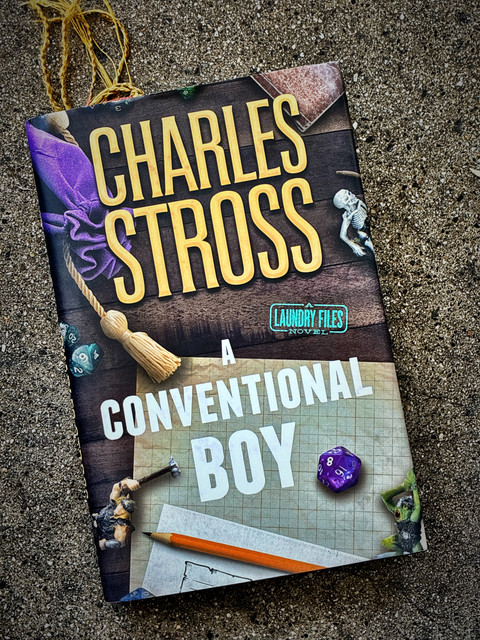
This collection contains a short novel (just 133 pages), two short stories, and an afterword which is both informative and thought provoking. As is often the case — especially with Charles Stross — the total is more than the sum of its parts.
The titular novella is the story of a Dungeon Master who is living in a controlled environment / prison camp. It’s not an ugly one; think ‘The Village’ from The Prisoner and now make it run down. Understandably, he yearns to get out after decades of isolation from the rest of the world. When he learns the camp is to renovated and its occupants relocated in the interim, as well as seeing an advertisement in a local newspaper (which is permitted to be brought in) that there is a D&D / TTRPG convention to be held nearby, he hatches a scene to be lost in the confusion of impending relocation and attend the event.
At the event he meets four people he has been corresponding with for years as part of an on-going game he’s Managing by mail. They register for what reveals itself to be far more than a LARP competition in the hotel’s confines.
Hijinx and saving the world ensue.
The first short story — “Overtime” — is a tale of a Christmas Party at The Laundry gone terribly wrong. Thankfully Bob Howard is on the job. Extremely well written and witty.
The second short story — “Down on the Farm” — concerns a secure facility where those who have served The Laundry are cared for when their health may cause danger to the public, or themselves. As a routine inspection, triggered by an internal complaint, Mr Howard is sent to see what’s up. Things happen as a result. Excellent and efficient story telling.
Then there is the Afterword which ties nearly all three of them together. To say that it is thought provoking is a pale imitation of what it accomplishes. It alone is worth the price of the volume, almost single-handedly explaining why the three stories exist at all.
In it, Mr Stross provides not only the history of the creation of the Table Top Role Playing Game “Dungeons and Dragons” and its countless offsprings, but also discusses the use of the genre by those who would limit others’ playing of anything which even smells of that progenitor. They are part of the Christian Right, who have their own images reflected back to them in a way they care not to face. Because many cannot abide their own worst realities, these ‘would be do-gooders’ seek to control others’ activities rather than face their own shortcomings or question their own beliefs and presumptions.
This blind approach to both the unknown, as well as any other unfounded claim about ’the underworld,’ continues from TTRPGs to the so-called ‘Satanic Panic’ of the 1980s. This was sparked with the publishing of the book, and then the release of the movie of, The Exorcist. It was then fuelled into a raging bonfire by the release of the book by psychiatrist Lawrence Pazder titled Michelle Remembers, purporting to be the recollections of Mr Pazder’s patient (who was also simultaneously his lover, then later his wife) of her physical and sexual abuse by a Satanic Cult located a short drive and ferry jaunt from my home. The entirety of the book — and any other Satanic Ritual claim thereafter — was debunked in the years following, but the damage was done and almost singlehandedly created the insanity which continued for at least ten years after.
The overlooking of actual child abuse at the hands of people in authority — both religious and not — is its own separate horrific reality.
The chief thing this fear of Satanic Ritual revealed was, predictably, the narrow-mindedness of those filled with panic. People at the top of the panic — Lawrence Pazder, eg — exploited those unable to critically examine the claims and amplification of danger, causing countless amounts of money to come their way, just as the Christian Right has done before and since under their own banners (and who also took advantage of this opportunity to make hay while the sun shone).
The second short tale is not linked with the foregoing, but allow me to be so bold as to undertake the task (and hopefully not incur the wrath of Mr Stross in so doing).
“Down on the Farm” contains a ‘villain’ which is an early 1960s IBM 1602 mainframe computer. Blind obedience to a machine — or even fear of it being The Devil — can be just as dangerous as the approach to D&D or religious belief systems other than one’s own as being inherently destructive to the norm. If a status quo is set by those in authority and an injunction is issued that it may not be questioned, or even adjustments be suggested, then this amounts to authoritarianism or dictatorship. This can be something as obvious as a Military General on a balcony, or as seemingly benign as a piece of computer machinery in a basement
The real question here is qui bonum, for if we know who benefits from the dictums issued we know who is in control. Odds are it is not The People.
I do not wish to herein create some sort of conspiracy myself, just provide a reminder that a healthy use of critical analysis is always a good thing, no matter who is doing the talking and — even especially — no matter if you trend to agree with them or not.
As always with work by Charles Stross: very highly recommended.
★★★★★